WordPress WPCode code-injection flaw, safe on 2.3.6 and later (CVE-2026-8832)
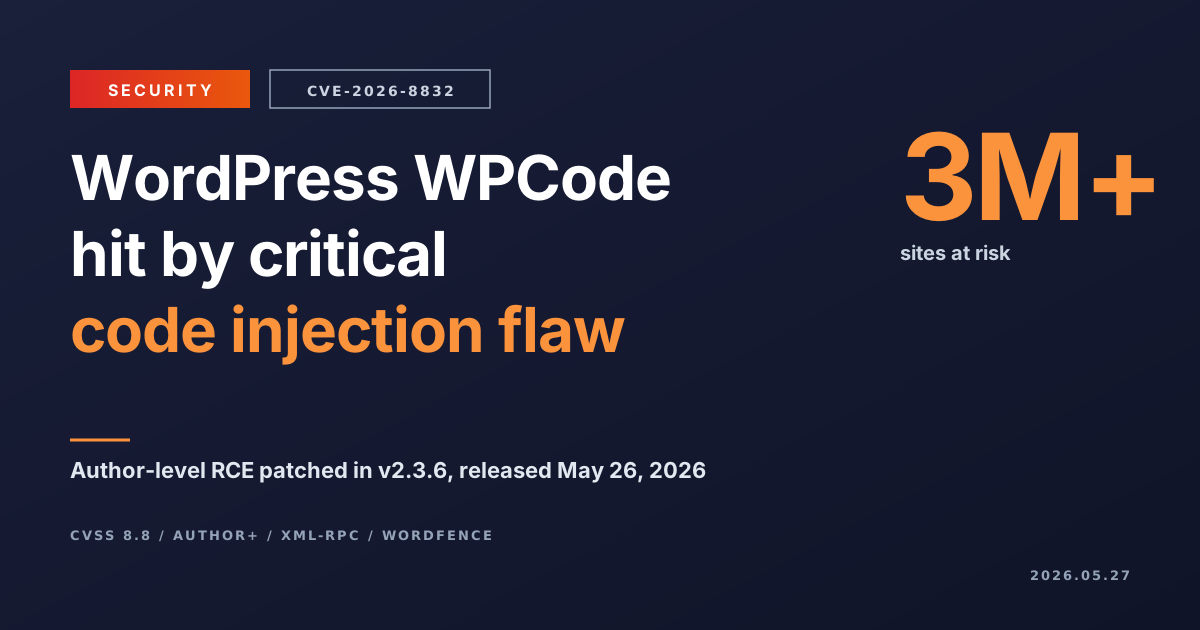
A code injection flaw (CVE-2026-8832, CVSS 8.8) has been disclosed in WPCode, a WordPress code-snippet management plugin installed on over 3 million sites. The flaw lets any user with Author-level access or higher run arbitrary code on the server. The vendor released v2.3.6 on May 26, 2026; Wordfence published the advisory on May 27.
Table of contents
A code injection flaw (CVE-2026-8832, CVSS 8.8) has been disclosed in WPCode, a WordPress code-snippet management plugin installed on over 3 million sites. The flaw lets any user with Author-level access or higher run arbitrary code on the server. The vendor released v2.3.6 on May 26, 2026; Wordfence published the advisory on May 27.
A code injection flaw in a plugin used by 3 million sites
WPCode, the WordPress code-snippet management plugin formerly known as Insert Headers and Footers, carries a vulnerability, CVE-2026-8832, that lets any account with Author-level access or higher execute arbitrary PHP on the server — a textbook code injection that turns into a full site takeover. The affected range is version 2.3.5 and earlier, and the flaw was fixed in 2.3.6. The current stable release is 2.3.8, so if your WPCode is 2.3.6 or later you need to do nothing further; anything older closes the hole once you update.
The fix landed in 2.3.6 in May 2026, and the plugin has kept moving since, through 2.3.7 and 2.3.8 (2.3.8 added a further permission tweak: editing a snippet now requires a dedicated activation capability). As of this update (2026-07-23) the bug is not in the CISA KEV catalog (the U.S. government list of vulnerabilities confirmed to be under active attack), and no large-scale in-the-wild exploitation has been reported. Even so, about two months on, a third party has published a working exploit tool on GitHub, so leaving an old version in place is not safe. One note on the severity number: Wordfence and NVD score it CVSS 8.8, while WPScan rates the same flaw 7.2 (both land in the second-highest "High" band).
What the people who take over 3 million sites actually walk off with
Behind the CVSS number and the attack-vector notation, it is worth asking who would actually pay to weaponize a bug that lets an Author account write PHP, and what they intend to monetize once they are inside. Looked at from that angle, this CVE points straight at WordPress site owners in a specific way.
The people who profit from sneaking in as Authors on three million live WordPress sites are not bored teenagers. The core list is: criminal crews who turn compromised sites into malware distribution networks, SEO spam operators who poison search results to funnel traffic to fake e-commerce and counterfeit pharmacy sites, coinjackers who silently install crypto miners in visitor browsers, Magecart-style skimmers who inject card-stealing code into checkout pages, and insider-style scam groups who deliberately enroll as contributors and then chase escalation. What they want is the site's admin privileges itself, footholds into neighboring sites on the same shared host, the cookies and session tokens of every visitor, subscriber email lists, and on WooCommerce sites, customers' names, addresses, and card details. Hit this CVE and a WordPress site with even one contributor on its roster becomes a web-shell-loaded distribution endpoint by the end of the day. A single Author account passes the PHP-snippet creation API, wp-config.php walks out the door, and database read-write keys go with it.
In cybersecurity terms, this combines "privilege escalation into arbitrary PHP execution" with a secondary "supply-chain-like" blast radius. WordPress Author privileges get handed out more widely than operators realize — to outside writers, contributors, and registered users on membership sites. The CVE is also reachable through xmlrpc.php, so just watching the wp-admin login log will miss the attack signatures. Once a PHP snippet is planted, the site's .htaccess gets rewritten and the property is converted into "an attacker-controlled malware distribution endpoint that ranks well in organic search." With three million installs of WPCode, the scannable target pool is enormous. A third party has already published a working exploit tool on GitHub, so the effort of writing attack code from scratch is gone.
An 8.8 score measures the damage on the server side, but the wound a WordPress owner actually carries lives somewhere else: readers and customers who opened "your trusted domain" walked away with malware or a skimmed card, and your domain ends up parked on Google Safe Browsing and vendor blocklists as the named distributor. Even after cleanup, delisting takes weeks, and during those weeks organic traffic and subscriber trust evaporate at the same time.
What WPCode is — the plugin that lets you stop touching functions.php
WPCode was originally written in 2011 by Syed Balkhi of WPBeginner. It is a code snippet manager that lets site owners drop Google Analytics tags, Facebook Pixel scripts, custom PHP, CSS or HTML into the right place from the WordPress admin UI, instead of editing the theme's functions.php. Started life under the unassuming name "Insert Headers and Footers" and was rebranded WPCode in 2022.
The WordPress.org listing currently shows "Active installations 3+ million", and the Wordfence summary cites "over 2 million websites" using the plugin. It is translated into 32 locales and is widely deployed across Japanese WordPress sites as well.
If you are not sure whether your site is affected, check the plugins list in the WordPress admin for either "WPCode" or "Insert Headers and Footers".
The exploit prerequisite — one Author account is all it takes
CVE-2026-8832 boils down to a missing permission check on the snippet creation and editing path. A request that should require Administrator privileges to add or modify a PHP snippet was accepted from accounts that only hold the Author role. WordPress's Author role normally lets you write and publish your own posts; it is not supposed to let you ship PHP that runs server-side. With this bug, that boundary collapses.
The CVSS 8.8 vector is AV:N / AC:L / PR:L / UI:N / S:U / C:H / I:H / A:H (this 8.8 is the Wordfence/NVD score; WPScan rates the same flaw 7.2): network exploitable, low attack complexity, low privileges required, no user interaction, full impact on confidentiality, integrity and availability. The awkward bit is "low privileges required". It is not unauthenticated, but Author accounts tend to accumulate quietly in places you forgot about:
- Outside writers and contributors who were given Author by default, because Administrator felt scary and Subscriber felt useless
- Membership sites where Author is handed out so users can write their own profile posts
- Existing low-privilege accounts that have been compromised through some other auth-bypass flaw and silently promoted
- Ghost accounts created via old form plugins that nobody noticed
The attack path also runs through XML-RPC. If xmlrpc.php is reachable, an attacker can reach the code injection without ever going through the wp-admin login UI. Disabling XML-RPC is a hygiene step that many WordPress sites still skip.
Three ways to check whether your site is affected in under a minute
If you can open wp-admin, use method 1. If you have SSH or command-line access to the server, use method 2. Method 3 is for cases where wp-admin is broken.
| Method | Steps | 2.3.6 or above means |
|---|---|---|
| 1. wp-admin | Plugins > Installed Plugins, look for "WPCode" or "Insert Headers and Footers", read the version column | Patched |
| 2. WP-CLI | Runwp plugin get insert-headers-and-footers --field=versionon the server | Patched |
| 3. File system | Openwp-content/plugins/insert-headers-and-footers/ihaf.phpand read the Version: header | Patched |
Once you know the version, the actual risk also depends on how many reachable Author accounts you have and whether XML-RPC is open. The matrix below sketches the real-world exposure:
| Your site state | Risk | Priority |
|---|---|---|
| 2.3.5 or below + external Authors + XML-RPC enabled | High | Update and audit promptly |
| 2.3.5 or below + external Authors + XML-RPC disabled | Medium-high | Update promptly |
| 2.3.5 or below + only you as Author + XML-RPC disabled | Medium | Update soon |
| 2.3.6 or above (latest is 2.3.8) | Low | Just look for unfamiliar snippets |
To check XML-RPC, append /xmlrpc.php to your site URL and load it in a browser. "XML-RPC server accepts POST requests only." means enabled; a 404 or access denied means disabled. To count Authors, go to Users > All Users in wp-admin and filter by role.
How to fix it — update to 2.3.6 or later, then audit Author accounts
WPCode published version 2.3.6 in May 2026. The changelog line "Tweak: We added extra permission checks around snippet creation and editing to ensure only authorized users can make changes" is the fix for this CVE. The plugin has kept updating since, through 2.3.7 and 2.3.8, so if you are updating now the surest choice is the current 2.3.8 (the "2.3.6 or later" in the table below includes 2.3.8).
Run through the following list in order.
| Priority | Action | How to check |
|---|---|---|
| 1 | Update WPCode to 2.3.6 or later | Plugins list in wp-admin, check the version column |
| 2 | Inventory all users with Author role or above | Users > All Users, filter by Author/Editor/Administrator |
| 3 | Disable XML-RPC if unused | "Disable XML-RPC" plugin or .htaccess block |
| 4 | Look for snippets you did not create | WPCode admin "Code Snippets", sort by updated date |
If auto-updates are on, 2.3.6 may already be installed. Even so, walk through the inventory and snippet review manually. An attacker who landed before the patch can drop a persistence backdoor as a snippet that survives the upgrade.
WordPress's role separation cracks again
WordPress has five built-in roles — Administrator, Editor, Author, Contributor, Subscriber — but plugins routinely add features without honoring those boundaries. CVE-2026-8832 is exactly that pattern: the PHP-snippet create/edit endpoint was missing the capability check that should have gated it to Administrators, so Author requests went through.
Structurally this is the same kind of bug as the "Login with OTP" (CVE-2026-8760) and "Firebase Support & Chat Management" (CVE-2026-8787) flaws disclosed earlier in May, when WordPress.org closed both plugins on May 19. A plugin re-implements its own authorization layer that does not line up with the core role model. The difference is scale: this time it happened in a plugin used by 3 million sites.
The operational lesson is to revisit who actually needs Author. WordPress's role model is fine for the use cases the core team designed for, but Author is heavier than most teams realize. If you need "write posts but cannot publish, no other capabilities", a fine-grained role plugin like User Role Editor gives you a much tighter blast radius the next time an "Author+" plugin CVE drops.
Severity — high impact, update soon if you are behind
Quick scorecard:
| Dimension | Rating | Notes |
|---|---|---|
| Blast radius | Large | 3 million installs, translated into 32 locales |
| Ease of exploitation | Medium | Author privilege required, but XML-RPC reachable |
| Impact severity | High | Arbitrary code = site takeover, pivots to malware hosting |
| Active exploitation | None reported (as of 2026-07-23) | Not in CISA KEV, no large-scale in-the-wild reports |
| Public exploit tool | Available | A third party has published a working tool on GitHub |
About two months on, the preparation phase — reverse-engineering the fix from the patch diff to work out the attack — is already behind us. A third party has published a working exploit tool on GitHub, and the attack chain (brute-force a WordPress login to obtain an Author account, then reach the code injection through XML-RPC) could be automated at any time. Given a pool of three million sites, unpatched installs should be treated as targets for automated mass scanning.
Recommendation: if auto-updates are on, confirm the version first; if not, do the manual update to 2.3.6 or later (the current release is 2.3.8) soon. The severity sits "high but not catastrophic", short of an unauthenticated CVSS 9.8 like IBM's WebSphere code execution flaw (CVE-2026-8633), but the install base means it is not far behind in reach.
One point to avoid confusion: in July 2026 there was news that "a WordPress RCE (arbitrary code execution on the server) was actively exploited and added to CISA's KEV". That was a separate flaw in WordPress core itself (nicknamed wp2shell, CVE-2026-63030 / CVE-2026-60137), not the WPCode plugin vulnerability covered here. The two are unrelated.
References
- •NVD — CVE-2026-8832
- •Wordfence Threat Intelligence — WPCode <= 2.3.5 Authenticated (Author+) Code Injection
- •WPScan — WPCode vulnerability list (scores CVE-2026-8832 as CVSS 7.2)
- •WordPress.org — WPCode Plugin Page (Active installations 3+ million, latest 2.3.8 changelog)
- •WPCode official site
- •WordPress documentation — XML-RPC Support

Backend Engineer / AWS / Django
Related articles

UsersWP's Second Flaw CVE-2026-13690 Bypasses 2FA; Update to 1.2.70
July 10, 2026
LatePoint CVE-2026-13228: 5.6.9 is no longer enough, update to 5.6.10
July 1, 2026
Data-Theft Flaw in WordPress 'The Events Calendar', Fixed in 6.16.3
June 16, 2026
WordPress Plugin Vulnerabilities: Easy Invoice and GeekyBot Are Fixed in the Latest Versions
June 16, 2026
Max-Severity Takeover Flaw in a WooCommerce Invoice Plugin: CVE-2026-52704, Update to 2.0.9 Now
June 16, 2026
Magento Mirasvit Cache Warmer Takeover Flaw, Fixed in 1.11.12+
June 4, 2026
WordPress 'Kirki' flaw CVE-2026-8206 now exploited to hijack admins on 500k sites
June 2, 2026